Electronics and Communication Engineering
About the Department

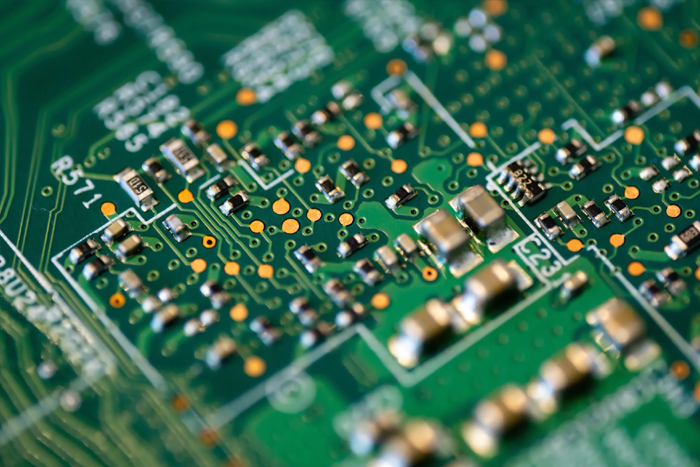
The Electronics and Communication Engineering department started in the year 2009, offers an undergraduate course and a post graduate course in applied electronics that is relevant to the future careers of our students. The Department has reaccredited by NBA for the three years(2023-24 to 2025-26). The department provides fundamental and applied skills in engineering, computing and mathematics. This allows individuals with diverse backgrounds to enter, succeed, and continue the life-long learning process in their chosen careers.
Students have enormous opportunities in the sectors like telecommunication, space research, embedded based automation industries, communication networks and information technology.
The department is enthusiastically involves in the early development of students’ personality, communication and soft skills to make them feel their pride themselves in the modern and globally competitive environment.
The distinctive strength of the department is the excellent coordination in carrying out the academic responsibilities. The department has a separate block which includes state-of-the-art laboratories and advanced library facilities.
Vision
- To be a centre of excellence in Electronics and Communication Engineering for the benefit of the society and industrial needs.
Mission
- To develop industry oriented education for deep knowledge and skills in the field of electronics and communication engineering.
- To provide excellence in academics and in research for making the students employable and entrepreneurs.
- To enable the graduates to face societal challenges with ethics and human values for providing holistic solutions.
Programme Details
Engineering graduates will be able to:
- PO1: Engineering knowledge: Apply the knowledge of mathematics, science, engineering fundamentals and an engineering specialization to the solution of complex engineering problems.
- PO2: Problem analysis Identify, formulate, review research literature, and analyze complex engineering problems reaching substantiated conclusions using first principles of mathematics, natural sciences, and engineering sciences
- PO3: Design/development of solutions: Design solutions for complex engineering problems and design system components or processes that meet the specified needs with appropriate consideration for the public health and safety, and the cultural, societal, and environmental considerations.
- PO4: Conduct investigations of complex problems: Use research-based knowledge and research methods including design of experiments, analysis and interpretation of data and synthesis of the information to provide valid conclusions.
- PO5: Modern tool usage: Create, select and apply appropriate techniques, resources and modern engineering and IT tools including prediction and modeling to complex engineering activities with an understanding of the limitations.
- PO6: The engineer and society: Apply reasoning informed by the contextual knowledge to assess societal, health, safety, legal and cultural issues and the consequent responsibilities relevant to the professional engineering practice.
- PO7: Environment and sustainability: Understand the impact of the professional engineering solutions in societal and environmental contexts, and demonstrate the knowledge of, and need for sustainable development.
- PO8: Ethics: Apply ethical principles and commit to professional ethics and responsibilities and norms of the engineering practice
- PO9: Individual and team work: Function effectively as an individual, and as a member or leader in diverse teams, and in multidisciplinary settings.
- PO10: Communication: Communicate effectively on complex engineering activities with the engineering community and with society at large, such as, being able to comprehend and write effective reports and design documentation, make effective presentations, and give and receive clear instructions.
- PO11: Project management and finance: Demonstrate knowledge and understanding of the engineering and management principles and apply these to one’s own work, as a member and leader in a team, to manage projects and in multidisciplinary environments
- PO12: Life-long learning: Recognize the need for, and have the preparation and ability to engage in independent and life-long learning in the broadest context of technological change
The Graduates will be able to:
- PSO1: Apply modern tools to solve real time problems in Embedded, VLSI, Communication and Networking.
- PSO2: Adapt to work in a multidisciplinary areas related to electronics and communication engineering to meet societal needs.
- B.E. Electronics and Communication Engineering
- M.E. Applied Electronics

Dr.S.Menaga M.E.Ph.D
Assistant Professor (Sr.G)

Dr.J.Nandhini M.E.Ph.D
Professor & Vice Principal

Ms.J.Paruvathavardhini M.E.,(Ph.D)
Assistant Professor (Sr.G)

Mr.N.Dhanaraj M.E
Assistant Professor (Sr.G)

Mr.T.Mani M.E.,(Ph.D)
Assistant Professor (Sr.G)

Ms.D.Mohanapriya M.E.,(Ph.D)
Assistant Professor

Ms.G.Sivasathya M.E.
Assistant Professor

Ms.R.Swaranambigai M.E.,(Ph.D)
Assistant Professor

Mr.N.Malligarjunan M.E.
Assistant Professor
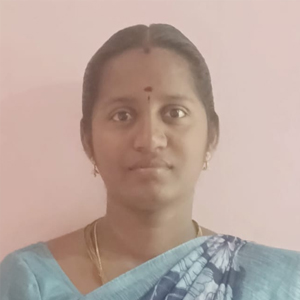
Mrs.M.Malar
Assistant Professor

Ms.T.Janani
Assistant Professor

Ms.P.Suganya
Assistant Professor

Ms.M.Manju
Assistant Professor
Laboratory Facilities
- Electronics Laboratory
- Digital and Linear Integrated Circuits Laboratory
- Optical and Microwave Laboratory
- Networking and Simulation Laboratory
- Analog and Digital Communication Laboratory
- Microprocessor and Microcontroller Laboratory
- Electronics System Design Laboratory
- Embedded Research Laboratory
Consultancy
Value Added Courses
- Value Added Courses are offered in the department to nurture the student’s technical skills and enhance their knowledge in developing technologies.
- A number of courses are organized in the department and the students may choose their willing course based on their choice. This helps them to perform better during their project development and placement.
The following value added courses are offered and students got benefitted
- Proteus &Keil
- LABVIEW
- Raspberry Pi
- MATLAB
- VLSI
Spice software (T-spice &Pspice)
Library
Departmental library of Electronics and Communication Engineering Department is equipped with over 900 reference books which cover complete syllabus of UG in Electronics and Communication Engineering as well as competitive examinations such as GATE, UPSC etc.
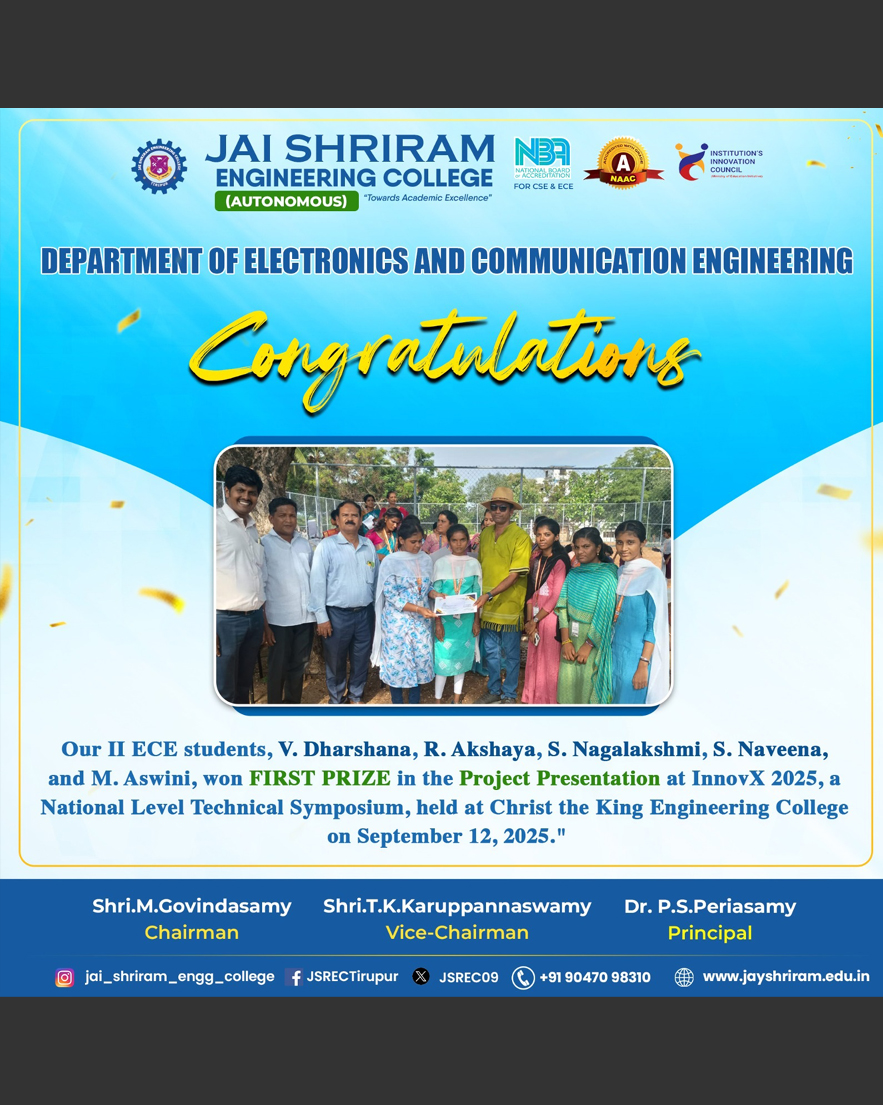
Achievements